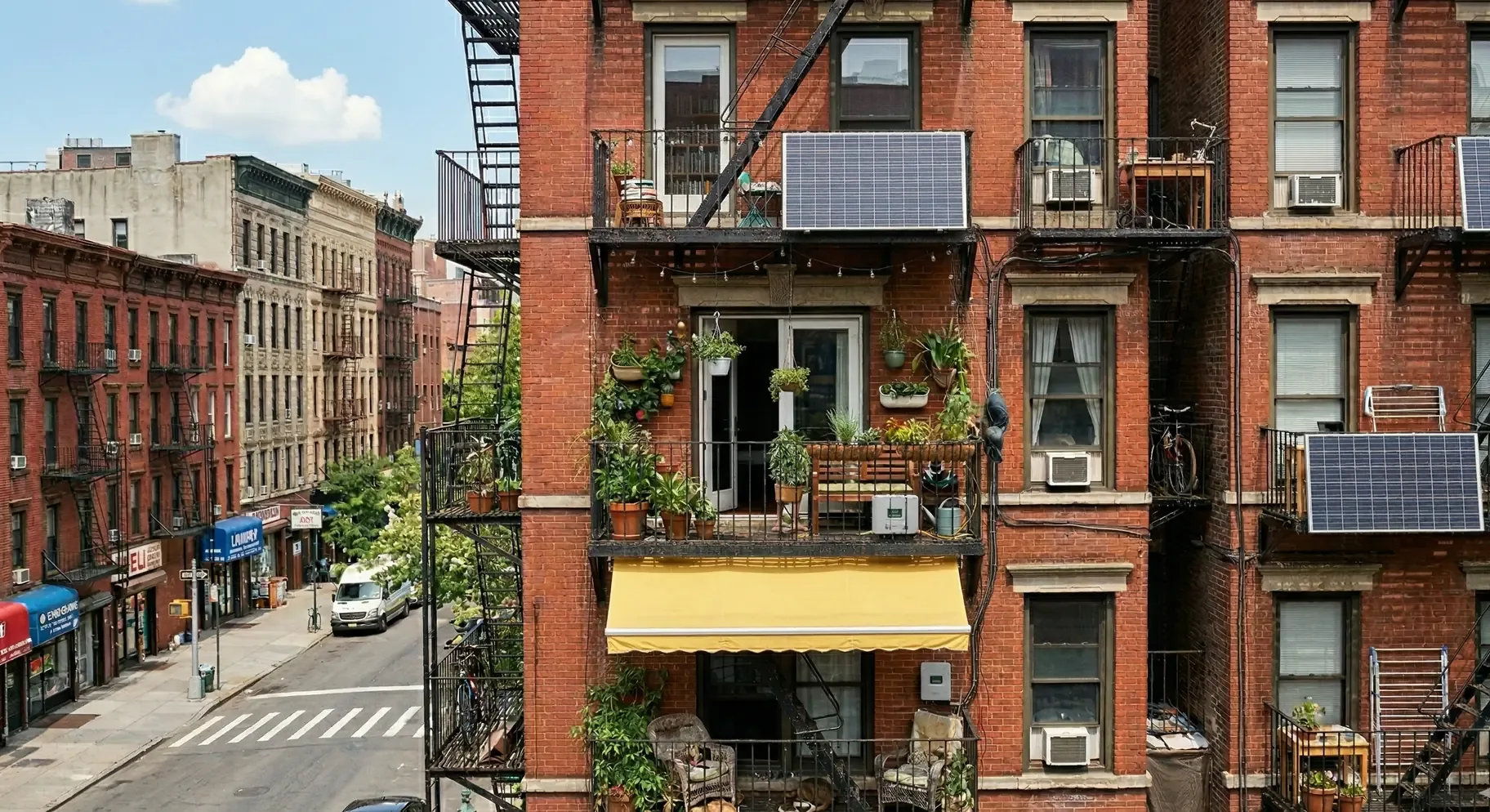
Illustration only. Never mount panels on a fire escape or block another exit route.
Enter an NYC address, then choose the wall and floor. You’ll get an estimate of annual output, bill savings, and CO₂ avoided for an 800W system.
Manual details use NYC floor and density averages for shading, so this estimate is less precise than pinning your exact balcony in 3D.
Illustration only. Never mount panels on a fire escape or block another exit route.
A typical kit has one or two panels, a mounting system, and a microinverter. It supplies part of the apartment’s daytime power; the grid supplies the rest.

Most setups use 400 to 800 watts of panels. They clamp to a suitable railing or sit on a weighted stand; the roof is not involved.
A microinverter converts the panels’ DC output to 120V AC. A certified kit plugs directly into a properly rated, weather-protected outlet. If the balcony has no suitable outlet, adding one may require a licensed electrician and building approval.
While the panels are generating, their output supplies part of the apartment’s load. The meter records less electricity coming in from the grid.
An 800 W balcony system produces roughly 400 to 900 kilowatt-hours a year in this model. At the 2026 Con Edison marginal rate, that is $136 to $306 in first-year savings if the apartment uses all of the power as it is produced.
| Annual output | Year-one saving | Payback, $1,200 kit | 25-year net |
|---|---|---|---|
| 400 kWh poorly sited | $136 | 8.1 years | +$3,435 |
| 550 kWh | $187 | 6.0 years | +$5,175 |
| 700 kWh | $238 | 4.8 years | +$6,915 |
| 900 kWh well sited | $306 | 3.8 years | +$9,235 |
Payback assumes 3% annual rate growth and 0.5% panel degradation. It is a best-case estimate because exported power earns no credit under the SUNNY Act. Actual savings depend on how much electricity the apartment uses while the panels are generating. See the full calculation.
Con Edison’s 2026 marginal rate includes supply, delivery, and surcharges. It excludes the fixed monthly charge because solar cannot reduce it. See how the rate is calculated.
A New York household uses about 6,850 kWh a year on average. Producing 400–900 kWh would cover roughly 6% to 13%; the share of the bill actually avoided also depends on when the apartment uses power.
Sky view and nearby shadows create most of the roughly 3× range between the lowest and highest estimates. Direction matters too. See what affects balcony sunlight.
An 800 W balcony system in New York City produces roughly 400 to 900 kWh a year in this model, worth about $136 to $306 at the 2026 Con Edison marginal rate of 34¢/kWh. With the calculator’s $1,200 mid-range cost assumption, modeled payback is about 3.8 to 8.1 years. Floor level, nearby buildings, and direction drive most of the range. These figures assume all generated power is used in the apartment. See the full range →
Not yet. New York still requires utility approval for plug-in solar. The SUNNY Act (S8512C/A9111C) has passed the State Senate and Assembly and is awaiting the Governor’s signature. If signed, it would remove that utility requirement 90 days later. It would grant no right to install, so renters and co-op owners may still need landlord or board approval. Read the current status and limits →
Not every apartment. Production depends on how much sky the balcony can see, its floor level and direction, and nearby buildings. In the calculator’s model, a high-floor south-facing balcony can produce about three times as much as a low-floor north-facing one. The model includes buildings within 200 m, but it cannot assess the railing, outlet, or building rules.
A microinverter converts the panels’ DC output to 120V AC. A certified kit should plug directly into a properly rated, weather-protected outlet using the manufacturer’s cord — never an extension cord, power strip, or adapter. If the balcony has no suitable outlet, adding one may require a licensed electrician and building approval.
Treat the result as a planning estimate. We use a modeled uncertainty range of about 15%, but no metered NYC balcony systems have been checked against it yet. The model captures shadows from nearby buildings, not smaller obstructions such as an AC unit or tree, and it cannot know the panel’s exact angle.
We run NREL PVWatts hour by hour and adjust the result with a 3D model built from NYC building data. Savings use Con Edison SC-1 rates; emissions use EPA eGRID. Read the full methodology →
Bright Saver is a useful price benchmark, but not a New York option yet. As of September 2026, its 360W kit is $414.17 for members, plus $29 per year, or $699 for nonmembers. It says it cannot ship the kit to New York because no kit yet has the required whole-system certification. For an 800W system, this calculator uses hardware-only assumptions of $850, $1,200, or $1,600. Open Adjust assumptions to change the tier.
Savings use a 2026 Con Edison residential marginal rate of about 34¢/kWh. That includes supply, delivery, and surcharges, but not the fixed monthly charge, which solar does not reduce. Open Adjust assumptions to change the bill and rate-growth settings. See how the rate is calculated →
Details on New York law, sunlight, installation, kit prices, and the electricity rate used in the estimate.
Current bill status, utility rules, and building permission.
Panels, microinverters, the outlet, and the apartment circuit.
How direction, floor height, and nearby buildings affect output.
Building permission, outlet safety, mounting, and wind loads.
Current kit prices and payback at four output levels.
How supply, delivery, and surcharges add up to about 34¢/kWh.